


Opens in a new tab. Your article title and link are shared only with the AI assistant you choose.
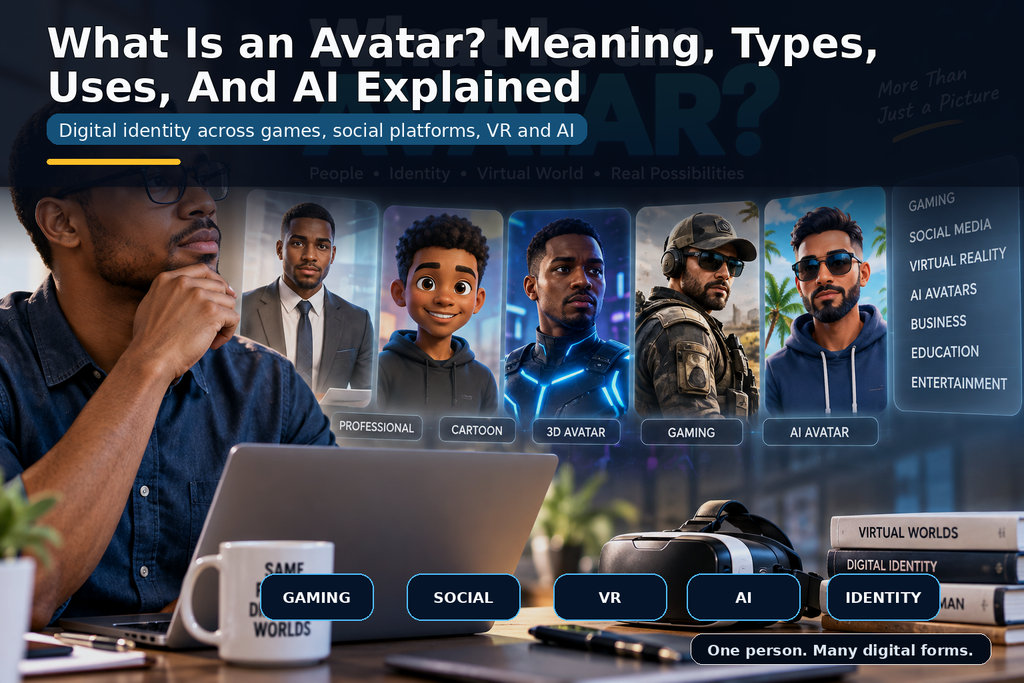
What is an avatar? An avatar is a visual, digital, or embodied representation of a person, character, idea, or identity, commonly used in games, social platforms, virtual worlds, and AI-powered experiences. The word also has an older Hindu meaning, where an avatar refers to the earthly manifestation of a deity.
Today, an avatar can be a simple icon, a cartoon version of you, a 3D game character, a VR body, or a lifelike AI presenter. Knowing the differences helps you choose the right format for each platform. Keep reading for more details.
What Is an Avatar and Where Did the Term Come From?
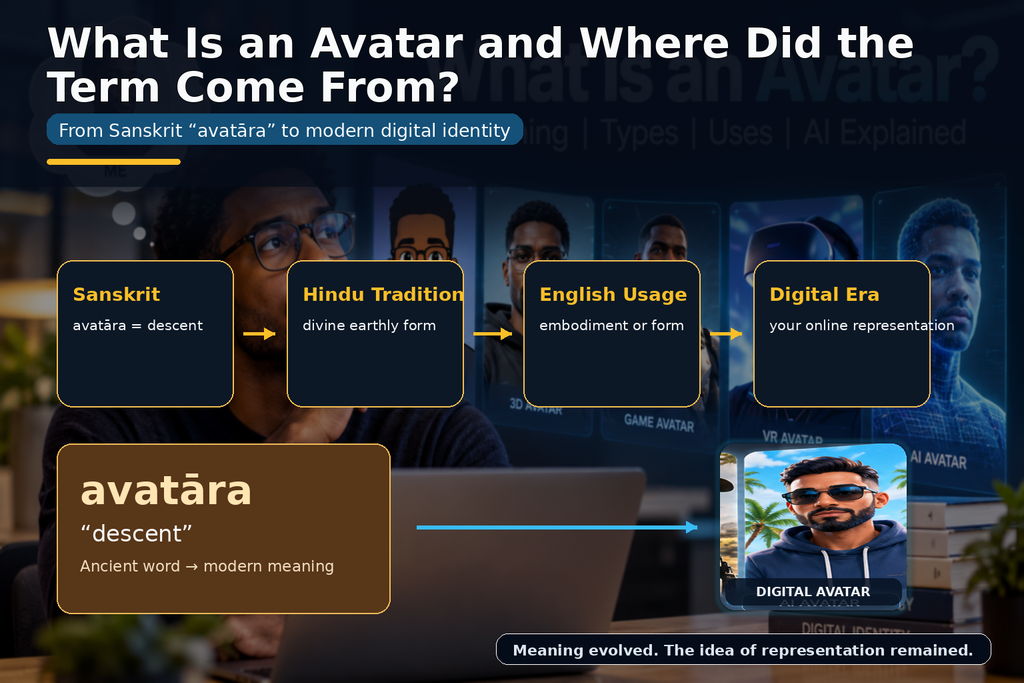
In modern digital use, an avatar is a representation that stands in for you inside an online or virtual environment. Merriam-Webster defines it in computing as an electronic image that represents a computer user and that user may manipulate. The word comes from the Sanskrit avatāra, meaning “descent,” and its first known English use dates to 1784.
The religious meaning first appeared in Hindu traditions, describing a deity appearing in earthly form. English later broadened the word to mean an embodiment of a person, quality, or idea, and digital culture adopted it for users. XPRIZE traces the computing sense through the 1979 PLATO game Avatar and Ultima IV in 1985.
If your goal is a polished visual identity, an AI-driven profile picture generator can create a professional-looking image without manual design work. That tool focuses on profile presentation, while a full avatar may also include a body, voice, movement, or interactive behavior. A profile image and an avatar can overlap without being identical.
Must-know Tip: Use “avatar” when the representation acts as your stand-in inside a digital experience. Use “profile picture” when the image mainly identifies your account.
What Are the Main Types of Avatars?
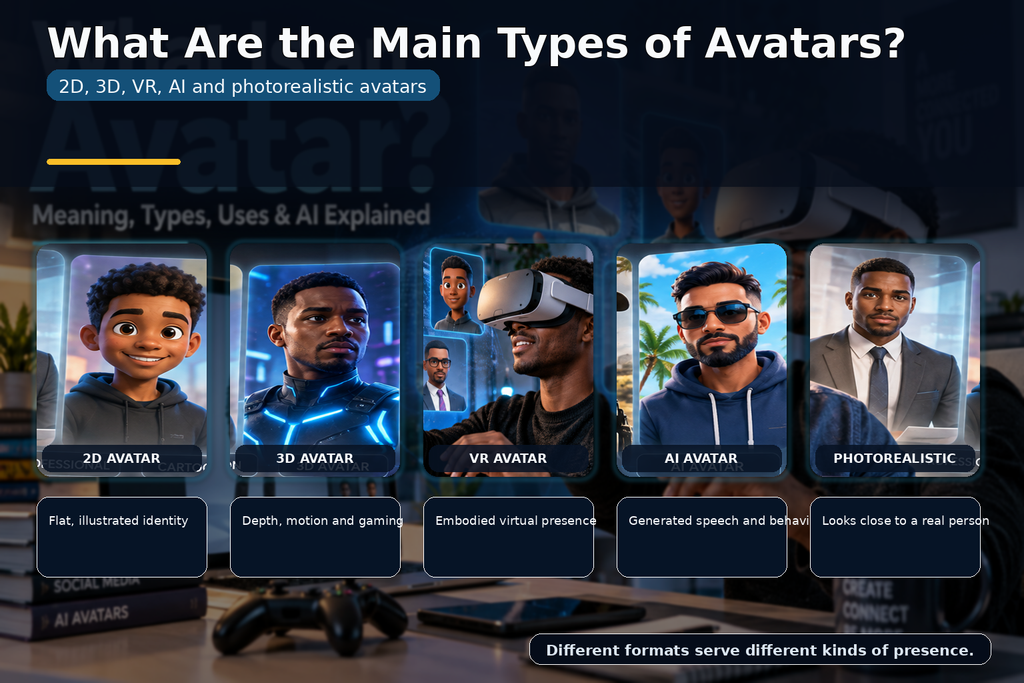
Avatars range from static icons to responsive digital humans. A 2D avatar may be a cartoon, Bitmoji, or forum icon, while a 3D avatar can have a full body, clothing, gestures, and movement. Snap reported in November 2025 that more than 320 million people used Bitmoji globally every day.
2D, 3D, and VR Avatars
2D avatars work well when you need fast recognition with little interaction. 3D and VR avatars add depth, motion, facial animation, hand tracking, or body tracking for games, meetings, social VR, and training. In 2026, the ESA reported that 212 million Americans played video games weekly, equal to 67% of Americans ages 5 to 90.
AI and Photorealistic Avatars
AI avatars can be generated from photos, text, video, or voice recordings. Some create still images, while others synthesize speech, lip movement, expressions, or responses. Deloitte reported in 2025 that 53% of surveyed U.S. consumers were using or experimenting with generative AI, up from 38% in 2024.
A cartoon icon may need little sensitive information, while a realistic AI double may depend on your face, voice, or motion data. The more lifelike the avatar, the more carefully you should review consent and data use.
Avatar vs Profile Picture, Character, NPC, Emoji, and Digital Twin
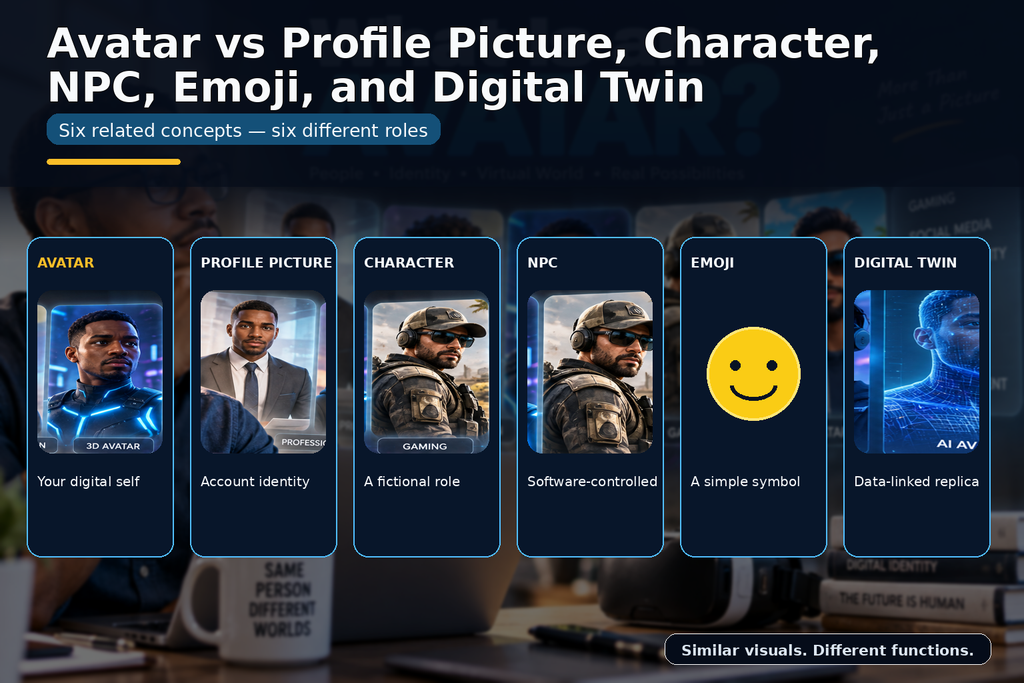
An avatar and a profile picture can both represent you, but they serve different roles. A profile picture mainly identifies an account, while an avatar may move, speak, or act inside a digital environment.
An avatar also differs from an NPC, or non-player character. You or your inputs usually control an avatar, while the game or software controls an NPC through scripts, rules, or AI. Merriam-Webster explicitly distinguishes its digital-avatar definition from a non-player character.
Emoji, Bitmoji, and Memoji overlap with avatars. An emoji is a standardized symbol, while Bitmoji and Memoji create personalized visual versions of a user that can function as avatars.
A digital twin usually models a real person, object, system, or process using data that may update over time. An avatar emphasizes identity or presence, while a digital twin emphasizes modeling, monitoring, or simulation. The two can merge when a realistic avatar uses live biometric or behavioral data.
Must-know Tip: Ask what the representation is designed to do. Identification suggests a profile picture, player control suggests an avatar, autonomous behavior suggests an NPC, and data-driven simulation points toward a digital twin.
How Do Avatars Work in Games, Social Media, VR, and AI?
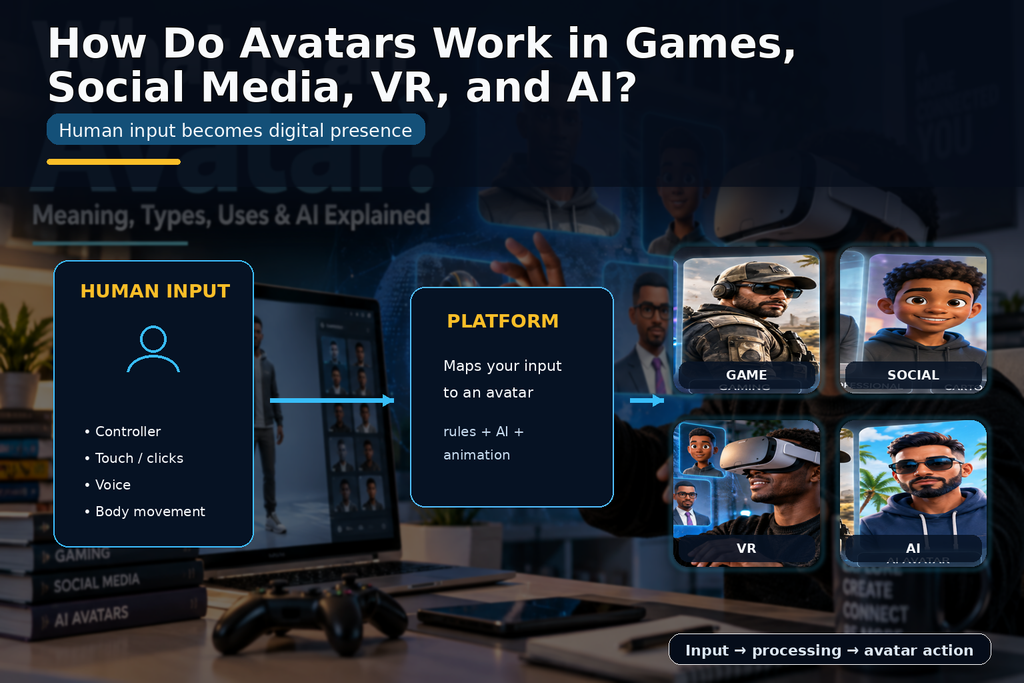
A basic avatar links a visual representation to your account and inputs. Games map controllers, keyboards, touchscreens, or motion signals to the avatar, while VR can map your head, hands, gestures, and body movement into 3D.
The social side matters too. ESA data for 2025 showed that 89% of U.S. players had played games online, 55% played with others weekly, and 79% of Gen Alpha and Gen Z players played with friends. Avatars therefore operate in spaces where appearance and behavior affect recognition, communication, and group identity.
AI avatars add generated speech, movement, or responses. Deloitte found in 2025 that 51% of regular generative-AI users used the technology daily, while work-related GenAI use among employed respondents rose from 6% in 2023 to 34% in 2025. That trend supports growing use of virtual presenters, assistants, training characters, and synthetic hosts.
The Proteus Effect
Avatars can also influence the person using them. Research by Nick Yee and Jeremy Bailenson found that people may adjust behavior to match features of their digital self-representation, a phenomenon called the Proteus effect. Their experiments found that taller avatars encouraged more aggressive negotiation, while more attractive avatars encouraged more social behavior.
Must-know Tip: Stanford researcher Jeremy Bailenson said, “When you’re getting serious in the metaverse, you want to look like you.” That is useful guidance for professional settings where recognition and trust matter.
Why Do People Use Avatars and How Should You Choose One?
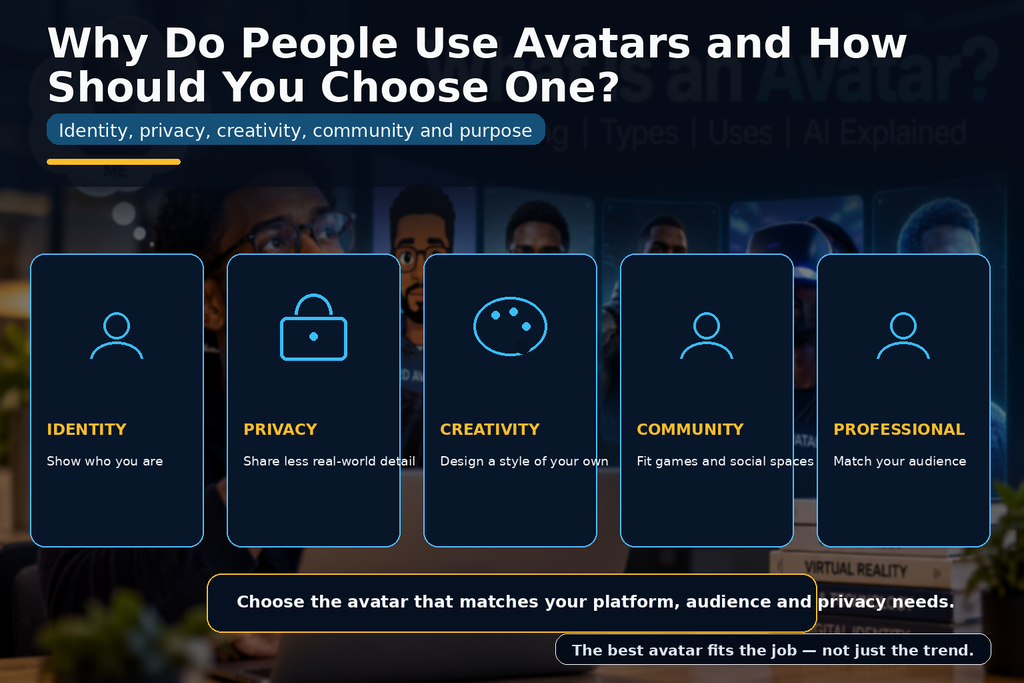
People use avatars because they provide control over digital identity. You can show personality without publishing your exact appearance, keep a recognizable style across platforms, create a fantasy identity, or gain visual privacy.
Gaming shows how broad avatar use has become. The ESA reported in 2026 that the average U.S. player was 37 years old, and 84% of Americans under 18 played video games. Avatars are therefore part of online life across age groups, not just among children or dedicated gamers.
Choose your avatar based on the platform and audience. Use a recognizable image for professional profiles, a 3D avatar for movement or spatial presence, and a stylized character when privacy or creativity matters more. Look for useful export formats, editable results, suitable resolution, and clear usage rights.
For a realistic AI avatar, inspect voice consent, facial-data handling, deletion controls, and whether the result could be mistaken for genuine footage. The best avatar is not always the most realistic one. It is the simplest representation that delivers recognition, expression, privacy, and the functions you need.
Are AI Avatars Safe? Privacy, Deepfakes, and Identity Risks
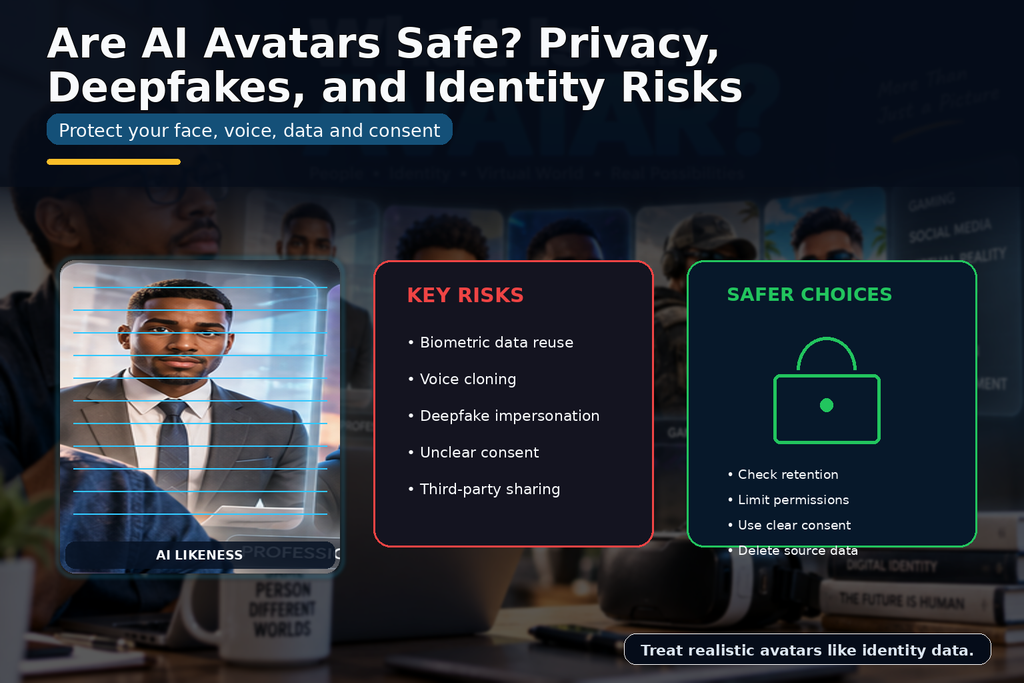
Realistic AI avatars may rely on facial images, voice recordings, motion data, or other biometric information. Before uploading, check what the service stores, whether it trains models on your files, how long it keeps them, whether you can delete them, and what reuse rights you grant.
Deloitte reported in 2025 that 70% of surveyed U.S. consumers worried about privacy and security in digital services, while 82% of GenAI users believed the technology could be misused. In 2024, 68% of people familiar with or using GenAI worried about being fooled or scammed by AI-generated content, and 51% said they had become more skeptical of online information.
Separate an authorized AI avatar from a deceptive deepfake. An authorized avatar uses a person’s likeness with permission, while deceptive synthetic media can imitate someone without meaningful consent and may support fraud, manipulation, or false endorsements. Use clear consent, limit unnecessary data collection, secure source files, and label realistic synthetic media when viewers could mistake it for authentic footage.
Must-know Tip: Treat a high-fidelity avatar like identity data, not just artwork. If a platform can reproduce your face and voice convincingly, review its privacy, deletion, consent, and reuse terms first.
Conclusion
What is an avatar? It is a representation that stands in for a person, character, idea, or identity, from the ancient religious meaning of divine incarnation to today’s profile icons, game characters, VR bodies, and AI-generated digital humans. The key difference between an avatar and similar concepts is purpose: avatars represent presence, profile pictures identify accounts, NPCs act under software control, and digital twins focus on modeling real systems.
Modern avatars can make online interaction more expressive, private, and immersive. Realistic AI avatars also raise questions about consent, biometric data, impersonation, ownership, and trust. Match the avatar to your audience, platform, privacy needs, and level of interaction rather than choosing realism for its own sake.
Keep reading for quick answers to common questions about avatars and digital identity.
Frequently Asked Questions
What Is an Avatar in Simple Words?
An avatar is a picture, character, or digital version that represents you online. It may be a simple icon or an interactive 3D person.
Can an Avatar Be a Real Photo?
Yes. A real photo can function as an avatar when it represents you on a digital platform.
What Is an AI Avatar?
An AI avatar is a digital representation created or animated with artificial intelligence. It may generate speech, expressions, video, or responses.
Is an Avatar the Same as a Profile Picture?
No, although they can overlap. A profile picture mainly identifies an account, while an avatar may also move, speak, or interact.
What Is the Difference Between an Avatar and an NPC?
You normally control an avatar or provide its inputs. An NPC is controlled by the game or software.
Why Do People Use Avatars?
People use avatars for privacy, self-expression, gaming, branding, entertainment, and virtual presence. They can provide a consistent identity without requiring a real photo.
What Is a 3D Avatar?
A 3D avatar is a digital character with depth that can be viewed from different angles. It may support movement, gestures, expressions, and clothing.
What Is the Proteus Effect?
The Proteus effect describes how an avatar’s features can influence the behavior of the person using it. Research has linked avatar characteristics with changes in confidence and social behavior.
Are AI Avatars Safe to Use?
They can be safe when you use reputable services with clear consent, security, retention, and deletion policies. Use extra caution when a service requires biometric data.
What Is the Difference Between an Avatar and a Digital Twin?
An avatar primarily represents identity or presence. A digital twin is usually a data-linked model used for monitoring, analysis, or simulation.


Comments
0 responsesNo comments yet. Be the first to share your thoughts.